How to choose
Choosing a first road bike without buying twice
Fit first, then the frame, then the parts that wear. The budget split that survives three years, and the federal requirements a new bike already meets.
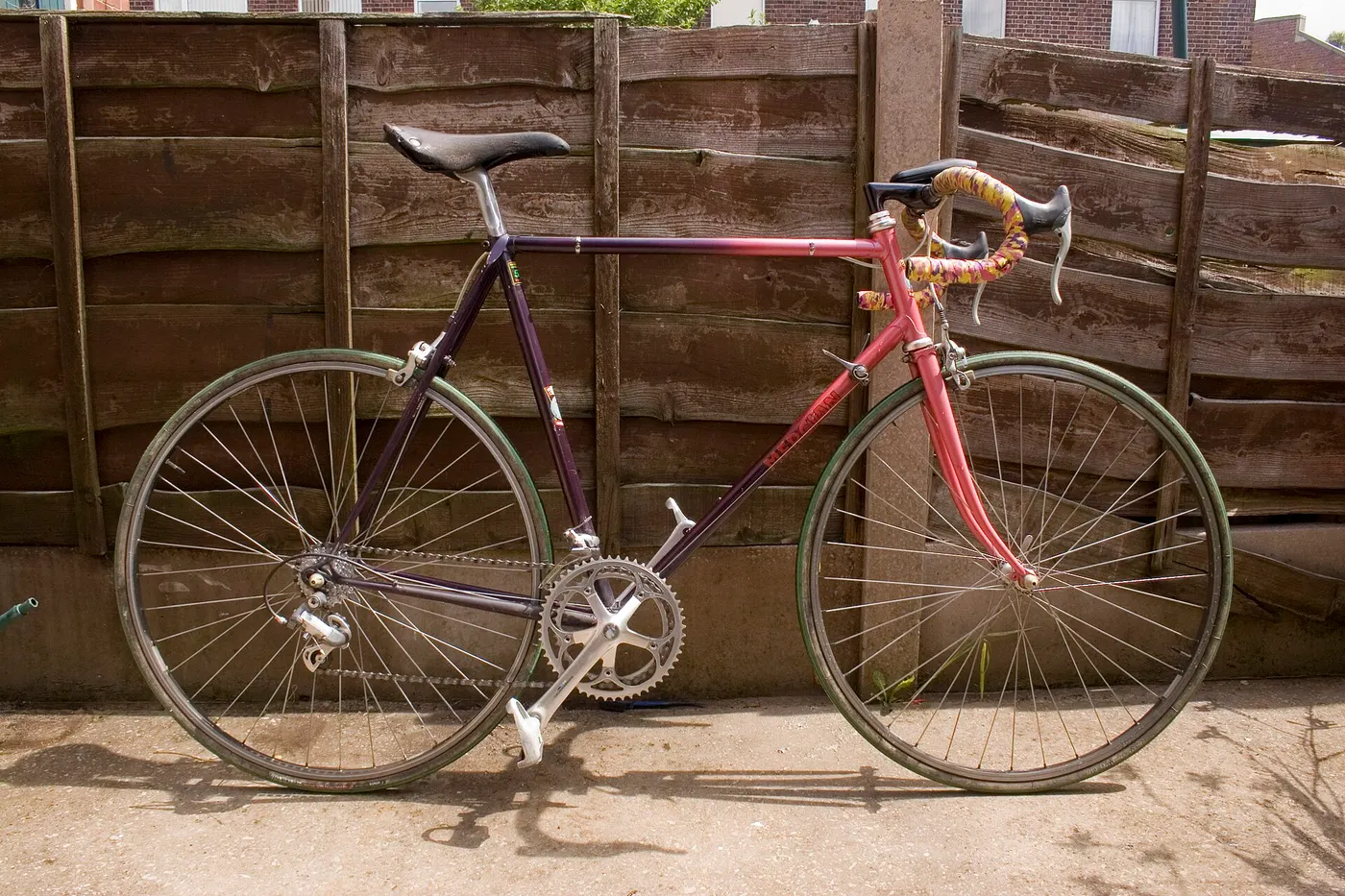
Most regretted first bikes are the right bike in the wrong size, or the right bike with no money left for the things that make it rideable. Both are budget-order problems rather than product problems.
This guide takes fit first, because it is the only thing that cannot be upgraded later, then the budget split, then the parts worth paying for, then what a bike sold in the United States is already required to have. Prices are example figures, labelled as such in the same sentence; this site has no price feed and quotes no seller.
Fit is the one thing you cannot change afterwards
A frame has two numbers that matter and one that does not. Stack and reach describe where the handlebars sit relative to the bottom bracket, and they decide whether you can hold the bars without your lower back doing the work. The seat tube length printed on the size label is a historical measurement that tells you less every year, because modern frames slope.
Stem length, saddle position and bar width are adjustments, and a shop will move all three. Reach is not. If a frame is 20 mm too long in reach, no stem swap fixes it without putting the steering somewhere unpleasant, and the usual outcome is a bike that gets ridden 4 or 5 times a year rather than weekly.
The practical test is 20 minutes on the bike, not 2 minutes in the car park. Ride it up a hill and down one, take both hands to the drops, and look for whether your shoulders creep towards your ears. Discomfort that appears at 20 minutes becomes pain at 2 hours, and the bike you buy is the one you will be on for 2 hours.
- Ask for stack and reach in millimetres rather than a frame size letter
- Ride the candidate for at least 20 minutes, including a climb and a descent
- Check you can hold the drops for 2 minutes without shrugging
- Confirm which parts the shop will swap at no cost: stem, saddle and bar width are the usual three
- Buy the frame that fits over the groupset that impresses, every time
The budget split that survives the first year
A bike without lights, a lock, a pump and a helmet is a bike you cannot ride to most of the places you wanted to ride to. Allowing 25% of the total for those items is the difference between riding in week one and riding in month three.
On a $1,200 total that is $900 of bike and $300 of kit. On a $700 total it is $525 and $175, and on a $2,500 total it is $1,875 and $625. The split holds at every level because the kit scales with the bike only partly: a lock for a $1,875 bike costs more than a lock for a $525 one, but a pump does not.
Spending the kit money is also the cheapest insurance against the bike sitting unused. A rider with a floor pump at home keeps the tyres at pressure, and tyres at pressure are the difference between a bike that rolls and a bike that feels like hard work for no reason the rider can name.
| Total budget | Bike at 75% | Kit at 25% | What the kit covers |
|---|---|---|---|
| $700 | $525 | $175 | Helmet, front and rear light, lock, mini pump, multi-tool, 2 tubes |
| $1,200 | $900 | $300 | The same plus a floor pump, shorts and a better lock |
| $2,500 | $1,875 | $625 | The same plus pedals and shoes, a computer and a chain wear gauge |
Allocations rather than product recommendations, and they assume you are buying everything at once rather than over two seasons. Our cost-per-mile guide shows what the first year of consumables then adds.
What a new bike sold in the United States already has
The Consumer Product Safety Commission regulates bicycles under 16 CFR part 1512, and its business guidance sets out what a compliant bike arrives with. Bicycles must have front and rear brakes, or rear brakes only, and when the hand lever is pushed down with 10 pounds or less applied 1 inch from the end of the lever, the brake pads must contact the braking surface.
The same guidance fixes which lever goes where: unless a customer specifies otherwise, the hand lever that operates the rear brake must be on the right handlebar, and the lever that operates the front brake must be on the left. That matters when you borrow or buy used, because a bike set up the other way round will catch you out in the first emergency stop.
Reflectors are also mandatory rather than optional. The requirement is a combination including a colorless front reflector, recessed colorless or amber reflectors on the back and front sides of the pedals, and a red reflector on the rear, plus wheel reflectors on the spokes or reflective rims or tyre sidewalls. A used bike missing its reflector set is a used bike with a small shopping list attached, and our safety guide costs that out.
| Requirement under 16 CFR part 1512 | What to check | Replacement cost if missing |
|---|---|---|
| Brake pads contact at 10 pounds or less, 1 inch from the lever end | Squeeze each lever; pads should bite well before the lever reaches the bar | Pads about $25 a set, as an example figure |
| Rear brake on the right lever, front brake on the left | Lift the rear wheel and squeeze the right lever | Cable swap, usually under $40 at a shop |
| Colorless front reflector and red rear reflector | Look at both ends of the bike | About $12 a pair, as an example figure |
| Pedal reflectors front and back | Spin a pedal and look at both faces | New pedals from about $25 |
| Wheel reflectors, or reflective rims or sidewalls | Look through the spokes on both wheels | About $8 a pair, as an example figure |
The requirements are quoted from the Commission's bicycle requirements business guidance. The replacement costs are example figures chosen to show the order of magnitude of a missing-parts list.
Where the money changes the ride, and where it does not
Wheels and tyres change how a bike feels more than any other component at this price level, because they are the rotating weight and the only contact with the road. A tyre upgrade at an example $70 a pair is the cheapest meaningful change you can make to a $900 bike.
Groupset tiers mostly buy weight and shifting refinement rather than function. A mid-tier drivetrain shifts under load almost as well as an expensive one and costs much less to replace when it wears, which it will: our cost-per-mile guide puts chain replacement at about $0.0175 a mile on example figures.
Frame material is the decision people over-think. Aluminium frames at this budget are light, stiff and cheap to replace after a crash; steel is comfortable and repairable; carbon at the bottom of the market buys a brand rather than a ride. For a first bike, the money is better placed in fit, wheels and the kit budget than in the frame material argument.
New, used, or a shop build
A used bike from a private seller saves roughly 40 to 50% on a 3-year-old frame, and costs it back in two ways: no warranty, and a drivetrain that may be most of the way through its life. A chain and cassette at an example $110 fitted turns a bargain into an ordinary price.
The check that decides it is chain wear, and it takes 2 minutes with a gauge. A chain at or past 0.75% elongation has usually taken the cassette with it, and a seller who has never heard of the measurement has probably never done it. Our maintenance arithmetic treats a chain as a 2,000-mile consumable at an example $35.
A shop build costs more and buys you the fit session, the first service and someone to go back to. At the $700 end that premium is a large share of the budget and a careful used purchase usually wins. At $1,200 and above the premium is a smaller share, and the fit session alone can be worth it on a bike you intend to ride for 5 years.
| Route | What you get | What you give up | Typical first-year extra |
|---|---|---|---|
| New from a shop | Fit session, warranty, first service included | The least bike for the money | Kit only, about $300 |
| Used private sale | Roughly 40 to 50% more bike for the money | No warranty, unknown drivetrain life | Kit plus about $110 of drivetrain |
| Used from a shop | A checked bike with some warranty | A premium over private sale | Kit plus about $50 |
Percentages and dollar figures are example planning numbers, not quotations. The drivetrain line assumes a chain and cassette replaced on arrival, which is the common case on a 3-year-old used bike.
Before you buy
- Set the total budget, then subtract 25% for kit before looking at any bike
- Ask every shop for stack and reach in millimetres rather than a size letter
- Ride each candidate for at least 20 minutes including a climb
- Confirm which parts the shop will swap free: stem, saddle and bars are the usual three
- On a used bike, measure chain wear with a gauge before agreeing a price
- Squeeze both levers and confirm the pads bite well before the lever reaches the bar
- Count the reflectors: front, rear, both faces of both pedals, and both wheels
Questions readers ask
- How much should I spend on a first road bike?
- Decide the total first, then take 25% off it for kit. At a $1,200 total that leaves $900 for the bike, which buys a well-fitting aluminium frame with a mid-tier drivetrain. Spending the full $1,200 on the bike and nothing on lights, a lock and a pump is the mistake that leaves the bike indoors.
- Is frame size the same as fit?
- No. Frame size letters and seat tube lengths are historical measurements, and sloping top tubes have made them unreliable. Ask for stack and reach in millimetres and compare those between candidates. Stem, saddle position and bar width are adjustable; reach is not, and a frame 20 mm too long cannot be fixed with parts.
- What should I check on a used bike?
- Chain wear first, with a gauge, because a chain at 0.75% elongation usually means a worn cassette and an example $110 of drivetrain. Then the federal basics: brake pads biting at 10 pounds or less of lever force, the rear brake on the right lever, and the full reflector set the Commission requires.
- Do I legally need the reflectors if I have lights?
- The federal requirement under 16 CFR part 1512 applies to the bicycle as sold, so a compliant new bike arrives with front, rear, pedal and wheel reflectors. State and local traffic rules about lights are separate and vary. Reflectors cost about $20 for the full set as an example figure, so replacing a missing set is cheap.
- Is carbon worth it on a first bike?
- Rarely. At the bottom of the carbon market the money has gone into the material rather than into the wheels, the fit or the kit budget, all three of which change the ride more. An aluminium frame with a $70 tyre upgrade and a proper fit session beats an entry carbon frame at the same total nearly every time.
Sources
Some links on this site can earn us a commission. That does not change which product a guide recommends, and it adds nothing to your price. Advertising is not enabled on this site yet. When it is, ads will be labelled and kept visually separate from the guides.